Payment services. What is what?

Zahlungsdienste | Payment Service | PayTechLaw

Do you know the type of questions where the answer depends on who you ask? An example of such a question is what constitutes a payment service. If you ask the legislator, the answer will be a more or less comprehensible but rather abstract catalogue of activities. If you ask a lawyer, he or she will tell you to look at the applicable law, because it is all stipulated in there. If you ask the rest of the population, the answer is usually a tired shrug of the shoulders.

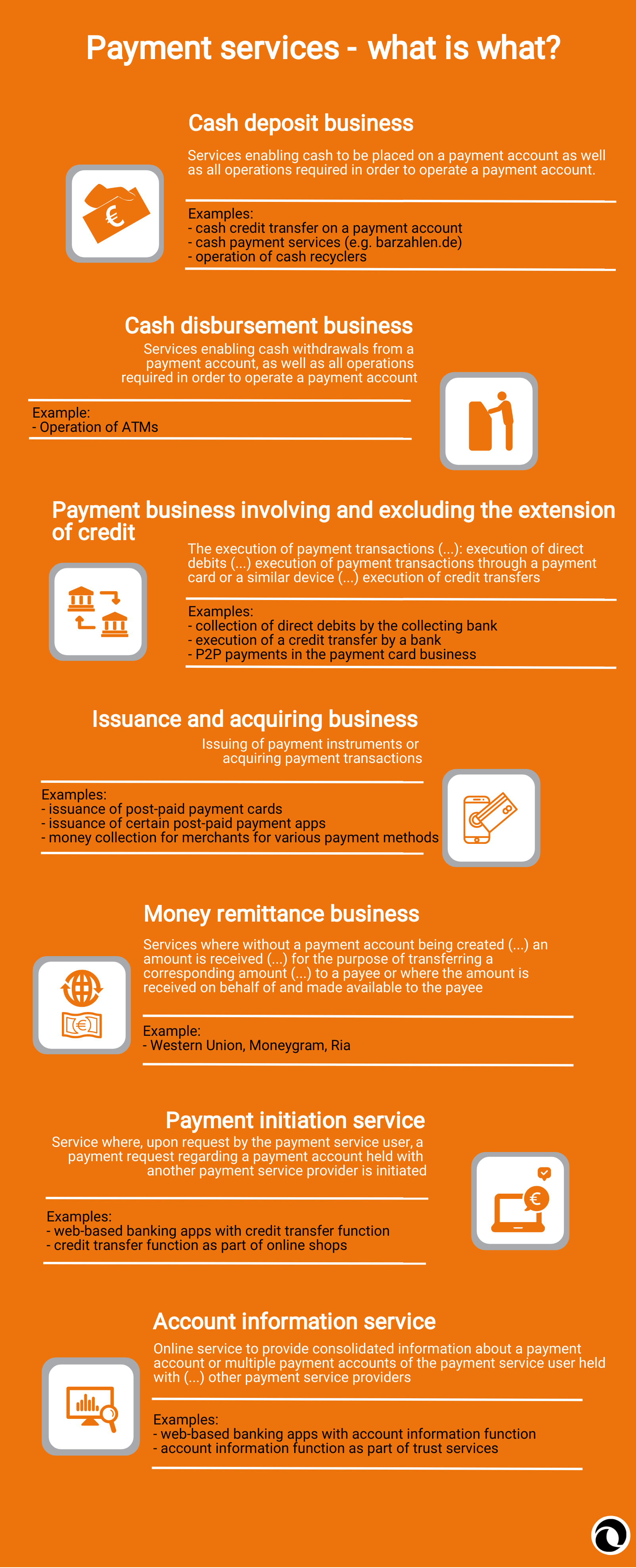
Our infographic provides clarification

Not happy with the situation? Neither are we! This is why we have created something for you. Our infographic shows what products are behind the various payment services. Even if this graphic is not complete, it gives you an overview of what constitutes a payment service. This will ensure that you can give a reasonably informed answer if ever asked what a payment service is.

Payment services. What is what? 1


By continuing, you accept our privacy policy.
You May Also Like
MiCAR trifft PSD2: Warum E-Geld-Token plötzlich doppelt reguliert werden | ALLES LEGAL #138
Read More

MiCAR meets PSD2: Why e-money tokens are suddenly subject to dual regulation | ALLES LEGAL #138

Since the end of the EBA transitional period in March 2026, many crypto-asset service providers have had to assess whether, in addition to MiCAR, they also require a PSD2 or national payment services licence. In this episode, Kemal Ahmedi explains why crypto regulation and payment services law overlap and what this means for business models and licensing strategies.
Read More
Datenschutz im Zahlungsverkehr – Rechtliche Grundlagen und Besonderheiten Data Protection in Payment Services – Legal Framework and Key Particularities
Read More

Data Protection in Payment Services – Legal Framework and Key Particularities

Data protection in payment services operates within the complex interplay of the GDPR, PSD2 and the German ZAG. A key challenge lies in the legal classification of payment data, as transaction data may reveal highly sensitive insights into individuals’ private lives. This article analyses the principal legal bases for data processing as well as the allocation of data protection responsibilities among payment service providers, PISPs and AISPs.
Read More
Ist bei E-Geld ein Vertrag zwischen dem E-Geld-Herausgeber und der Akzeptanzstelle erforderlich? Is a contract between the e-money issuer and the merchant required for e-money?
Read More

Is a contract between the e-money issuer and the merchant required for e-money?

This article examines the European Commission’s controversial interpretation of Article 11(7) EMD2 regarding the definition of electronic money. It focuses on whether a contractual relationship between the e-money issuer and the accepting merchant is required for electronic money acceptance. The article concludes that Article 11(7) EMD2 does not establish a general contractual requirement for the acceptance of e-money.
Read More